Welcome to Shenzhen Riqiya Electromechanical Co., Ltd. Official website!





|
|
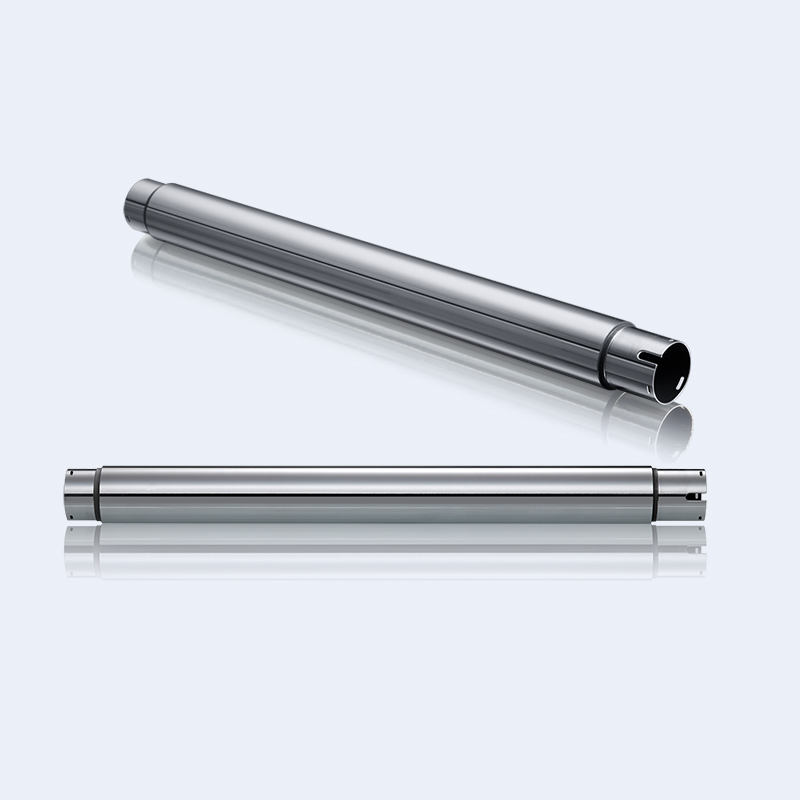
A through hole is made in the center of the shaft body, and an inner keyway is opened in the through hole. The outer surface of the shaft body is machined with a stepped cylinder and an outer keyway. The main shaft of the press chamber is sleeved, and the input power is directly transmitted to the main shaft of the press chamber through the transmission gear installed on the cylinder on the outer surface of the shaft to drive the shaft.
Feature Editing
The hollow shaft occupies a relatively large volume of space, but it can reduce the weight. According to the analysis of material mechanics, when the rotating shaft transmits torque, from the radial cross section, the more the outer place transmits the effective torque, the greater the effect. When the rotating shaft needs to transmit a large torque, a thicker shaft diameter is required. However, since the torque transmission at the shaft center is relatively small, a hollow one is generally used to reduce the weight of the shaft.
The hollow shaft occupies a relatively large volume, but it can reduce the weight.
According to the analysis of material mechanics, when the rotating shaft transmits torque, from the radial cross section, the more the outer place transmits the effective torque, the greater the effect. When the rotating shaft needs to transmit a large torque, a thicker shaft diameter is required. However, since the torque transmission at the shaft center is relatively small, a hollow one is generally used to reduce the weight of the shaft.
Purpose
"Fixing unit (one of the core components) for copiers and laser printers. The process of printing the toner image adsorbed on the paper, using the method of pressure and heat fusion, so that the melted toner is immersed in the printing paper to form a fixed image, is called ""fixing"".
The carbon powder adsorbed on the paper is a small particle mixed with thermal resin and carbon powder. When a metal roller with a high and small gap is between the gaps, the resin in the toner melts and is tightly pressed onto the paper together with the toner to form a permanent image, and at the same time complete the entire laser printing process. The melting temperature of the toner is about 100°C, and the temperature of the heat roller is related to the speed of paper passing, generally between 150 and 180°C. After cleaning the residual powder and light, the photosensitive drum enters the next cycle. The laser printer adopts the method of composite hot pressing, and uses the "fixing component" to complete the fixing. The working process of toner image fixing is as follows:
When the printing paper with ""toner image"" enters the fixing device from the paper guide When the heating roller is between the heating roller and the pressure rubber roller, the heating roller is heated by the heating lamp (185°C), and the pressure of the pressure rubber roller causes the toner to melt and immerse into the printing paper. The surface of the heating roller is coated with a polytetrafluoroethylene coating, which is not easy to adhere to the toner. Some models also have a layer of Teflon film on the surface of the pressure rubber roller, which helps the toner on the back side to not stick during double-sided printing. After heating and fixing, the printing paper is separated from the heating roller by the separating claw, and is led out by the paper discharge wheel to complete the whole fixing process.
"