Welcome to Shenzhen Riqiya Electromechanical Co., Ltd. Official website!





|
|
Composition
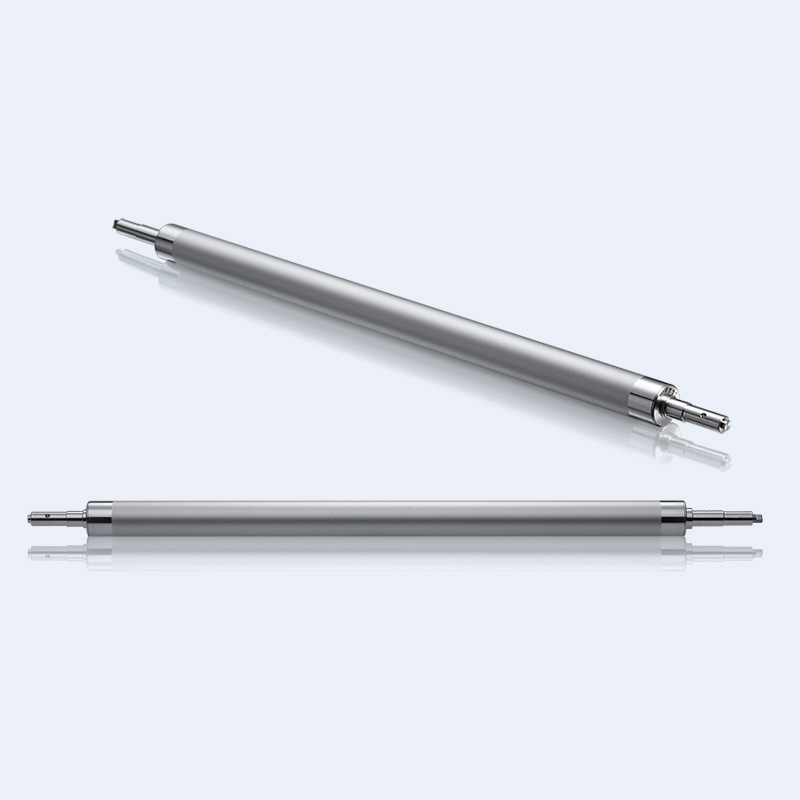
The magnetic roller is composed of a magnetic core, a bracket, a conductive wire and a magnetic sleeve; the magnetic sleeve is composed of an aluminum layer and a coating; the coating needs There is a certain degree of conductivity, wear resistance and roughness.
(1) The toner in the powder bin is attracted to the surface of the magnetic roller sleeve through the internal magnetic core.
(2) The carbon powder is charged with static electricity through the friction between the coating on the surface of the magnetic sleeve, the carbon powder particles and the polyurethane sheet on the powder ejection knife.
(3) The magnetic roller sleeve uses AC (alternating current) and DC (direct current) voltage to make the charged toner between the magnetic roller sleeve and the surface of the drum core OPC“ Beating”, so that the “electrostatic latent image” on the surface of the drum core is adsorbed to the toner.
Matters needing attention
(1) The surface roughness of the magnetic roller will affect the printing quality, so pay attention to it during use Protect the coating on the surface of the magnetic roller and its roughness.
(2) Do not overlap and press the magnetic roller during production to avoid deformation of the magnetic sleeve; do not touch the surface with your hands or oil.
(3) Note that the conductive wire or conductive spring on the conductive support of the magnetic roller can meet the normal contact with the conductive steel sheet of the magnetic roller during the assembly without deformation.
The magnetic roller is one of the components that has the greatest impact on the blackness of the print quality. The thickness and roughness of the black coating will change with continuous use. After blowing off the toner adsorbed on the magnet roller, if the black coating on the magnet roller looks very thin, even if you see the color of the aluminum base or the surface looks very shiny, then the print quality produced by such a magnet roller will be very good. Shallow, it should be replaced with a new magnet roller or magnet roller cover.
Purpose
The developing magnet roller is an important part of carrying toner. The permanent magnetic core does not rotate, and its function is to use magnetism to attract toner to the surface of the magnetic roller. The surface of the magnetic roller is sandblasted or drawn with a full circle of hundreds of axial shallow grooves to form electrical cavities with the toner scraper to facilitate toner transfer. When the magnetic roller loaded with toner rotates out of the position of the scraper, the toner on the surface of the magnetic roller is not only charged, but due to the force of the magnetic field, it forms a "magnetic spike", that is, a "toner mist". ;, Apply a bias to the outer sleeve of the magnetic roller, so that the magnetic spikes are arranged in an orderly manner. The function of the magnetic roller "spacer" is to control the effective attraction distance between the magnetic spike on the surface of the magnetic roller and the photosensitive drum, which is beneficial to improve the toner "bounce imaging".
Typical process
1. Magnetic block: plastic injection molding, magnetic alignment molding-magnetic block dewatering port-demagnetization -Cut off both ends of the magnetic block-Heat treatment-Straighten (complete to be assembled);
2. Axle core: Steel rod is formed and cut off on a cam lathe-Both ends are cut and ground Processing-milling-surface plating (completed to be assembled);
3. Flange: aluminum alloy is cut off on a cam lathe-forging forming-shaft end CNC turning processing-mating end CNC turning processing-flat milling-ultrasonic cleaning-pressing in the copper sleeve (completed to be assembled);
4.1 Casing: aluminum alloy round pipe fine drawing-cutting-CNC at both ends Turning-CNC surface turning-ultrasonic cleaning-surface sandblasting-laser machine inspection (completed to be assembled);
4.2 Casing: aluminum alloy grooved tube fine drawing-cutting-two End CNC turning-ultrasonic cleaning-laser machine inspection (completed to be assembled);
4.3 Casing: stainless steel pipe welding-cutting-outer diameter rough grinding-both ends CNC turning- Outer diameter fine grinding-ultrasonic cleaning-surface sandblasting-laser machine inspection (complete to be assembled);
5. Magnetic core: Coating glue-magnetic on the middle part of the shaft core Put the block and the shaft core into the mold and compact it-put it into the mold and magnetize-magnetic test (complete to be assembled)
6. Finished product: the magnetic core is put into the sleeve -Coat glue on the matching parts of the flanges at both ends-Press the flanges at both ends into the sleeve-Wipe the overflowing glue-Conduction check-Batch number printing-Laser machine detection-Roll wax paper protection.
Previous:Developing magnetic roller